Showing posts with label Hardware. Show all posts
Thursday, 7 November 2013
Red Harbinger Cross PC Desk

After a long design and development period, a full retail version of forum-member Peter Brands' (l3p) desk PC has finally been made available for pre-order in the USA, Canada, Europe and Australia.

The desk is based on Brands' Mod Of The Year winning desk PC, the aptly titled l3p desk. After winning the award Brands and six other compatriots set about creating a commercially viable desk PC case design, a process which was also logged on the forums. The result is a company called Red Harbinger, and its first product called simply the Cross. 


The design consists of a powder-coated metal desk into which is mounted space to fit two PCs, with two motherboard mounts (via a forthcoming Dual PC upgrade kit) along with loads of drive bays and space for other components, plus a plethora of ventilation grilles cut into the sides. This is all topped with scratch-resistant glass for easy viewing of your PC.

The cost? Well in the US the desk is on offer for $1,699, with those of us in Europe seeing a $390 flat rate shipping charge added on top bringing the total to $2,089 or around £1,350. Given some top-end PC cases retail for over £400 and a well made desk will be just as much, the price isn't unreasonable for what you're getting. 


We've seen a few instances of community-designed products making the leap from custom-made to mass-manufactured. And given the interest surrounding Brands' original desk design, it's no surprise that his L3p desk was snapped up with the promise of a retail version soon after. 

Take a look at the full specs below as well as the gallery and don't forget to let us know your thoughts in the forum. All we can say is WANT.

Specifications
  • Material: Steel and Aluminum, Powder Coated
  • PSUMount: 1 standard
  • Max PSU Mounts: 2*
  • Motherboard Compatibility: mITX, ITX, mATX, ATX, E-ATX†, XL-ATX†, SSI-EEB†, HPTX†
  • Standard Expansion Slots: 8, 10†
  • Maximum Expansion Slots: 8+8*, 10†+8*
  • 5.25” Drive Bays: 4 (2x2)
  • 3.5” Drive Locations: 8 (left side) + 12 (right side)
  • 2.5” Drive Locations: 6 (right side) + 12 (center, hidden)
  • Glass Type: Scratch Resistant, Tempered with Frosted Border, 10mm
  • Front Ports: USB 3.0 x 2, Audio, Mic, 22mm Power and Switch x 2
  • Max Front Ports: USB 3.0 x 4, Audio x 2, Mic x 2, 22mm Power and Switch x 4*
  • Cooling Fan Locations: 120mm x 3 (left), 120mm x 3 (right), 120mm x 8 (back)
  • Physical Dimensions (L x W x H): 59.1” x 28.6” x 30.1” (1502mm x 726mm x 765mm)
  • FEATURES:
  • Max GPU Length: 300mm standard (480mm with drive cage removed), 480mm†
  • Max CPU Cooler Height: 153mm
  • Covered Back PSU/Cooling Compartment
  • Optional Interior Leg-Mounted Shelving
  • Optional Interior Leg Mounted Headset Mount
  • Modular Tray System allows for conversion to Single/Dual/HPTX
  • Hollow Legs and Body Frame for optimal cable management and lighting.
  • Bottom Access Panels for cable management
  • Hidden Center Bridge compartment for 2.5” drives


Read more
Gigabyte Z87 Haswell Motherboard Round-Up

We’ve already seen what ASUS has to offer in the way of its Republic of Gamers Z87-based motherboards, and now we’re having a look at Gigabyte’s take on Intel’s latest chipset that supports 4th generation Core Series Haswell processors. Gigabyte sent us a sampling of three motherboards that offers a broad overview of the options in the company’s line: the solid and affordable Z87X-UD4H, their G1.Sniper5 gaming beast, and the Z87X-OC Force flagship overclocking board.


Gigabyte's Primary Z87 Features

The heart of Gigabyte’s Z87 platform is its Ultra Durable 5 Plus, which includes its heatsink design, CPU power design, and DualBIOS feature. The heatsinks on these Z87 boards vary somewhat from mainboard to mainboard, but as a line they offer passive, active, and water cooling setups around the CPU socket and chipset. For example, the Z87-UD4H has a passive heatsink, but both the G1.Sniper5 and Z87X-OC Force have fans and posts that are geared for liquid coolers.

The motherboards also feature an all-IR (International Rectifier) digital CPU power design, including PWM controllers and PowlRstage ICs that were built to work together to offer precision tuning and optimal cooling. 

Gigabyte’s DualBIOS design offers a main BIOS and a backup BIOS--literally, two separate chips--so that if something goes terribly wrong with the main BIOS, the backup is there to ensure that you can recover everything with no trouble.

The company is particularly proud of the quality of their board components. For example, these Z87 boards have black solid caps that are rated for 10,000 hours at 105 degrees C. The USB and LAN ports each have a dedicated protection filter for preventing damaging electrostatic discharges, and Gigabyte also used one fuse for every USB port instead of one fuse for multiple ports; the idea is that if a fuse blows, you only lose a single USB port instead of a whole bank. This is actually a rather attractive feature; USB ports are notorious for crapping out at times, so allowing one port to cough up a hairball while the rest remain healthy is a welcome build feature.

Further to the point of craftsmanship, the motherboards’ CPU sockets are gold-plated, which prevents corrosion and thus helps ensure a longer lifespan for the board itself; on some models, such as the Z87X-OC Force, the interior of the PCI and DIMM slots have gold, too. Finally, the PCBs have two layers of copper in the circuit board sandwich, which Gigabyte says enables larger power loads to flow from component to component and also wicks away heat better. 

Gigabyte has, as is typical, taken great care in the construction of these motherboards, employing small enhancements that add up. For example, the Z87 boards have a high-capacity front headphone amplifier designed to drive 600Ω loads, an Intel Gigabit LAN, and plenty of fan speed support. Each board has plenty of fan connectors (no fewer than 6), and Gigabyte put in OPT fan support, so users can implement a water pump that will run continuously at full speed (or just support a dual-fan cooler).

Gigabyte has also employed cFosSpeed traffic shaping and prioritization technology for better network performance and fast charging of mobile devices connected to USB (whether the computer is on or not) with On/Off Charge 2.

Read more
Wednesday, 6 November 2013
NVIDIA GeForce GTX Battlebox: 4K Gaming PC


Nvidia's outrageously high-end 'Battlebox' PCs focus on compromise-free 4K gaming


Don’t call it a Steam Machine! While Valve’s itty-bitty, living room-focused computers have been hogging the spotlight over the past week, Nvidia’s going big with its new ‘Battlebox’ initiative.
The graphics gurus have joined forces with a bevy of top-notch boutique builders to unleash a line of hulking, fire-breathing gaming PCs designed to play the latest and greatest shooters at whopping 4K resolutions without batting an eye.
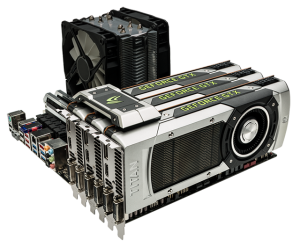
Each entry in the Battlebox line rocks at least a pair of Nvidia’s high-end GeForce Titan or GTX 780 video cards running in SLI, paired with overclocked Intel Core i5 or i7 processors, and abundant amounts of RAM. (Hey, it takes powerful hardware to push all the pixels processed at 4K resolutions.)

Nvidia claims that the heavy-duty Battleboxes manage to pump out an impressive 45 to 60 frames per second at 4K resolution with super-high detail settings and all of Nvidia’s proprietary bells and whistles—such as PhysX and TXAA anti-aliasing—enabled. That’s mighty impressive, and a clear dig at AMD’s audacious, console- and PC-spanning Mantle technology.
Nvidia specifically calls the graphics capabilities of Battleboxes “console-destroying,” though we’ve long known that top-end PC rigs would crush next-gen consoles—and they’d better, given the price of a Battlebox.
Simply put, glorious, compromise-free 4K gaming doesn’t come cheap. The rigs offered by the boutique partners Nvidia highlighted—Digital Storm, Falcon Northwest, Maingear, and Origin—start at over $2,000, and the most ridiculously top-of-the-line machines—like a fully pimped-out Digital Storm Aventum II—can set you back more than $10,000.
And no, that doesn’t include the cost of a 4K monitor itself. While the boutique builders will offer the 31.5-inch, 4K Asus PQ321Q display alongside Battleboxes, the monitor will cost you another $3,500. Alternatively, you could downsample the 4K video to work with your current 1080p, 1900-by-1200, or 2560-by-1440 monitor; it won’t be quite the same as native 4K, but it’ll still provide a big graphics boost, as evidenced by the screenshot below.
No matter how you pump out the visuals, there’s no question that Nvidia’s Battleboxes pack a nearly overwhelming amount of firepower. Sure, they’ll cost you an arm, a leg, and your firstborn child, but this is just about as future-proof as a PC can be—and it’s utterly wonderful to see companies basking in the raw, unadulterated potential of PC gaming.
If you’re not one of the PC-playing one percent, PCWorld has a guide to building a killer gaming PC for under $1,000. It won’t go toe-to-toe with a Battlebox, but it’ll rock your socks on a 1080p display.

Read more
Tuesday, 5 November 2013
Western Digital’s New Hard Drives


Western Digital’s New Hard Drives Are Filled With Helium


Storage is always getting cheaper and more capacious—but Western Digital has a plan to fill it with helium to make hard drives way more efficient than ever before.
If you could see inside a normal hard drive, you’d find it was a pretty brutal environment. The plates on which data are stored spin at incredibly high speed—thousands of revolutions per minute—and while you might not expect it, it’s the drag from those plates spinning through the air inside the drive that limits the number that can be stacked together. Yup, just like air resistance stops vehicles going fast, it does the same to your data.
But instead of air, Western Digital is now creating hard drives that are filled with helium, reports All Things D. Lighter than air, helium cuts the drag forces right down, allowing the manufacturer to squeeze more plates inside. Indeed, it can now squeeze in five where previously it could only manage seven; the first drive to roll off the production line has a capacity of six terabytes, versus four for conventional drives.
Perhaps predictably, the first units won’t be for consumers, but rather commercial enterprises. So, Netflix will be using them to store movies, and CERN to store experimental data. Then maybe, one day soon, you might have some helium in your hard drive, too.
Read more
Tuesday, 29 October 2013
Nvidia cuts high-end graphics card prices to fight AMD

Nvidia cuts high-end graphics card prices to fight AMD


In a textbook example of why competition is good, Nvidia has dropped the price on two of its high-end graphics cards, presumably to keep up with rival AMD.
Nvidia’s GeForce GTX 780 (shown above) is getting the largest price cut, from $649 to $499. That makes it $50 cheaper than AMD’s comparable R9 290X.
The less-expensive Nvidia GeForce GTX 770 is also getting a price cut, from $399 to $329. AMD still hangs onto a cost advantage here, with the comparable Radeon R9 280X retailing for $299.
To sweeten the deal, Nvidia is giving away a few free games with its high-end cards when purchased from select retailers, along with $50 to $100 off the purchase of an Nvidia Shield handheld.
PC Perspective reports that the price drops on Nvidia’s cards should go live by Tuesday on Amazon and Newegg.

Read more
Back To Top